To Die For (1995)

"You're not anybody in America unless you're on TV." Suzanne Stone assures us, her blonde bob impeccably coiffed, her Barbie doll make-up on point, wearing a pink blazer and addressing the audience in a close-up with a white background. "On TV is where we learn about who we really are. Because what's the point of doing anything worthwhile if nobody's watching? And if people are watching, it makes you a better person." Her monologues to camera are woven through the entirety of To Die For, just as the opening titles are intercut with newspaper clippings and tabloid imagery that detail a salacious murder case.
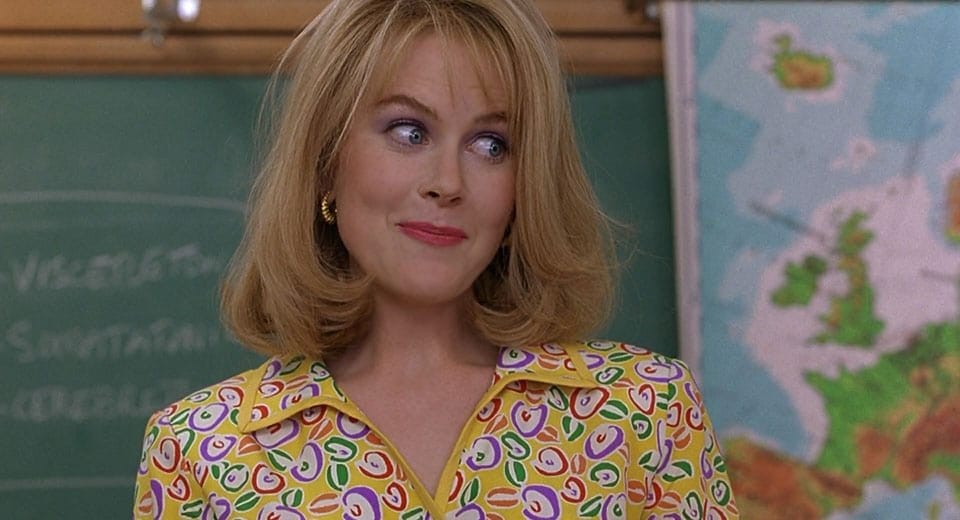
Suzanne outlines her world view, her opinions about the television industry, her dream of becoming a major on-camera personality. In telling the story of her marriage and her quest for success, she presents a polished demeanour, with a few sardonic asides and tearful reveries. The context for these monologues remains opaque, that is until the end of the film, when we are shown that Suzanne is conducting a video recording of herself, recounting her story after the fact, for a tape that will be delivered to a studio head, who claims to want to adapt her story into a movie.
The tape she is recording is just one part of Suzanne's "master plan". It is also just one strand in narrative that utilises drama and documentary-style interviews and TV appearances involving the main characters. Form and content are interlaced and lend the satire a multi-faceted quality. From Suzanne's opening remarks we cut to an interview with Janice Maretto, a cynical Italian-American ice-skater whose opinion of Suzanne could not be lower. She describes her initial read of her as being one four letter word, beginning with C. Cold. C-O-L-D. Her brother Larry, had a far more favourable impression.
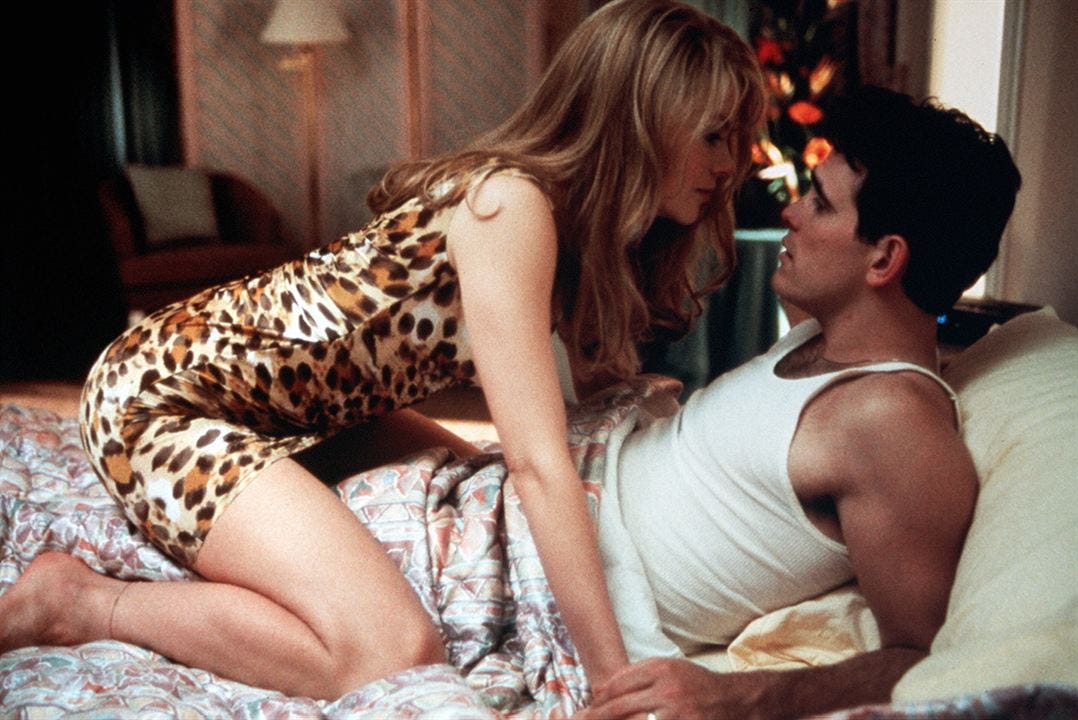
Flashback and we meet Suzanne and her posse taking shelter in a bar, where Larry is playing with his band. A beautiful woman in her early 20s, she's a small town girl with big dreams. She thinks highly of herself, believing she is destined for great things, and stands out immediately in the milieu of her small town. It doesn't hurt that she is played by Nicole Kidman, in her breakthrough performance. In this role, Kidman walks a tightrope between art and life, surely aware at the time of the media perception of her, an "unproven" talent who married a major film star, in a move that would obviously help her career. In To Die For, she plays someone willing to take drastic actions in the pursuit of fame. To see her play a character so hungry for attention and so adept at commanding it makes for an interesting dynamic.
For director Gus Van Sant (the visionary behind My Own Private Idaho) and screenwriter Buck Henry (co-writer of The Graduate), just casting Nicole immediately lent the character an intensity that propels the narrative, as well as an otherworldly "delicate China doll" quality that catches the attention of Larry Maretto (Matt Dillon). Suzanne and Larry ignite a fiery romance, all motorbike rides and wild sex, that soon leads to wedding bells. At one point outside the church, Suzanne whispers to her father "I'll still never find a guy like you, Dad" (much to his bemusement) then throws her bouquet (deliberately avoided by the jaded female wedding guests).

Both her father's nonplussed reaction and the women's indifference when faced with Suzanne zealous delusion, demonstrates the film's comical treatment of Suzanne. It's even more evident in the scene where Suzanne pitches herself for a job at the local TV station, totally overshooting the mark for what has been advertised as an assistant role, into a lofty speech about the power of television that she learned verbatim from an industry big wig at a conference, leaving the station managers baffled. Suzanne is in her own fairytale world, oblivious to the attitudes of others. All that matters to her is she creates her ideal reality, that is until someone stands in her way.
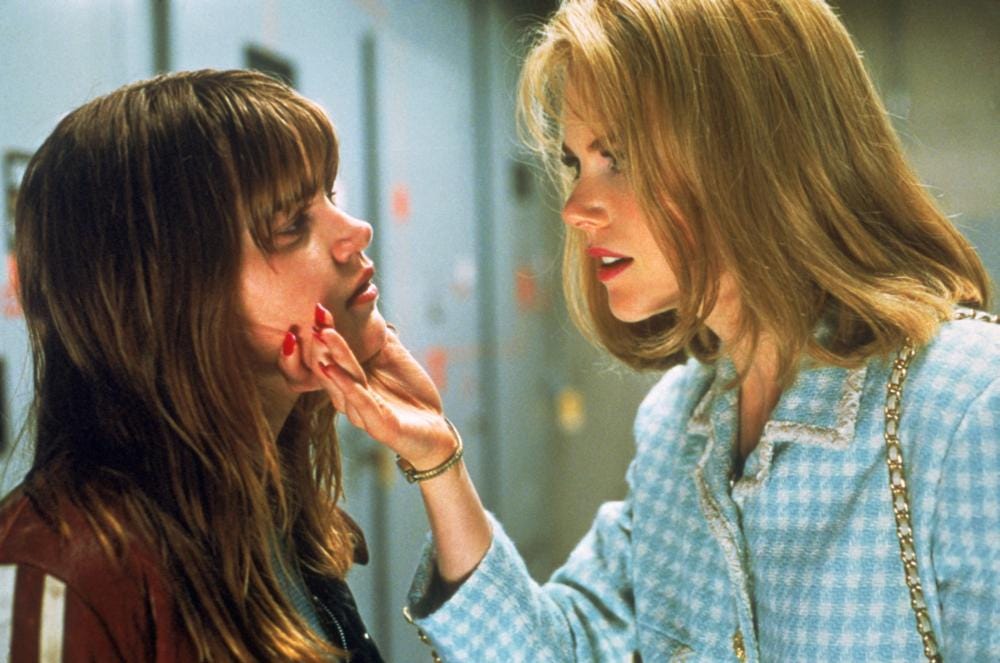
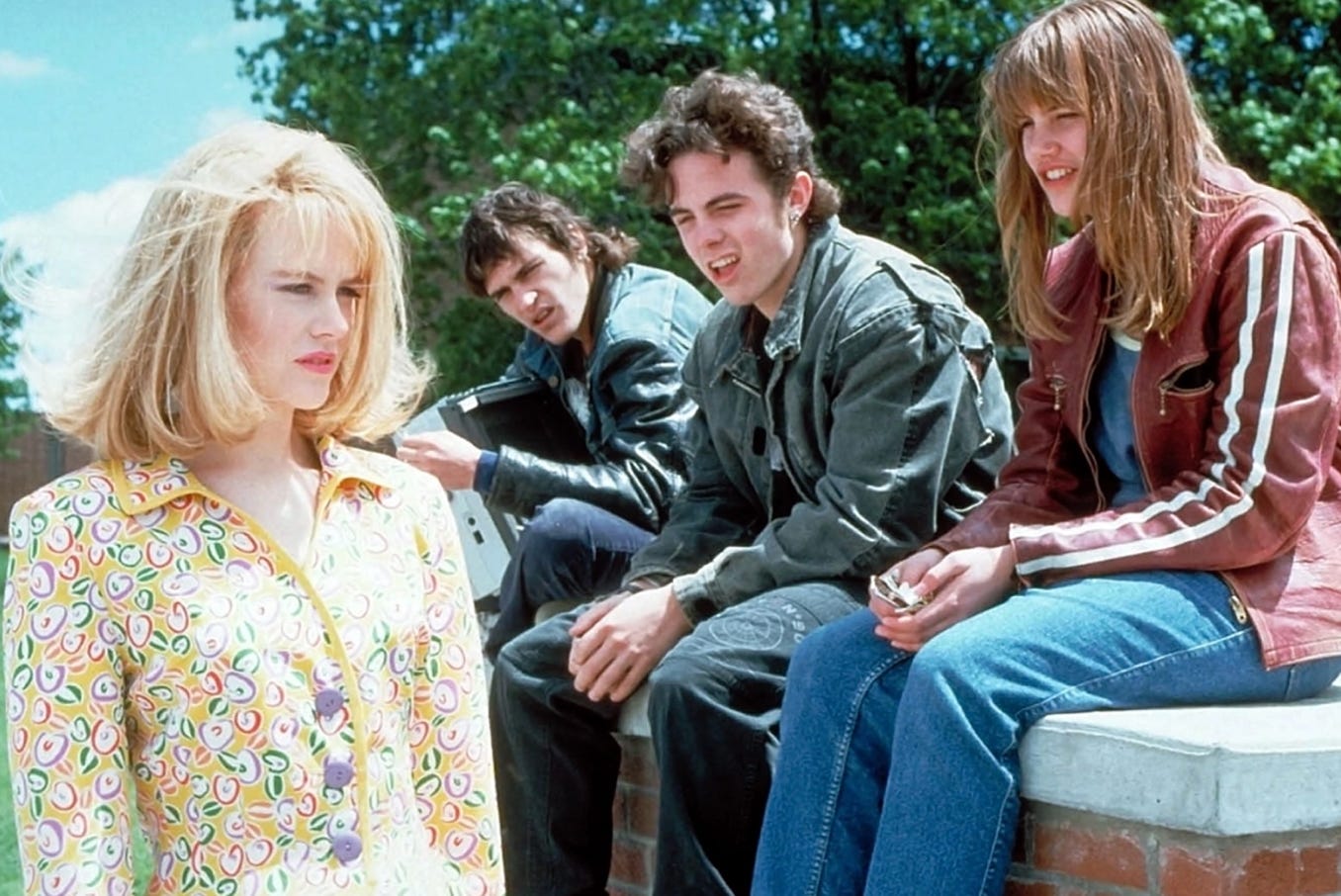
Suzanne gets the job working at the local TV station and wears them down until they let her deliver the evening weather report, but it isn't enough for her - she wants to be "the next Barbara Walters". She decides to visit the local high school and recruits a number of grungy teenagers into taking part in a human interest documentary called "Teens Speak Out". One of the three teens who sign up is Jimmy (played by a young Joaquin Phoenix) who is besotted with Suzanne. He is inarticulate, scruffy, and becomes devoted to her. The seduction between Suzanne and Jimmy becomes the heart of the film, and in her state of delusion, Suzanne begins to see her husband as an obstacle in the way of her plans. Larry puts his foot down and insists she put her career on hold to start a family. Suzanne realises that in order to achieve her goal of fame and notoriety, she will need to turn her own personal life into the "story", convincing Jimmy and his friends into killing her husband, and hoping that the media eats it up.
Kidman imbues the character with little details, like a signature flare of the eyes every time she pronounces "Stone" in Suzanne Stone. She has a playful quality, yet also a fiery temper and a cold determination that is otherworldly. The character is further defined by Danny Elfman's pulsating, fairytale-like choir and electric guitar, and the eye-catching costume design from Beatrix Aruna and Pasztor, who dress Suzanne in an array of colourful camera-ready ensembles. But for all the zeal and ambition in Kidman's performance and the slightly heightened tone the film achieves in portraying Suzanne, there is still a gravity and realism to the loss of Dillon's character, you feel the impact of his murder and how it affects the family. There is also real humanity to Phoenix' portrayal of the lovesick Jimmy, his misguided affection sealing his fate.
Why the title "To Die For"? At one point during their courtship Larry leaves Suzanne a box containing a Pomeranian puppy, and a note that reads "I'd die for your love"; he sees this incredible beauty with all her ambition, marries her, and he loses his life as a result. But there's also the dream that Suzanne is following, one that she is willing to do anything to achieve. Fame, power, success...is it really worth risking everything for? Ultimately, Suzanne meets an unfortunate end, buried under a sheet of ice on a lake. Janice, her sister-in-law, skates to the tune of Donovan's "Season of the Witch", dancing on her grave.